
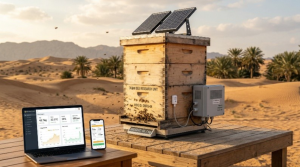
Detecting Disease Before It Strikes
Building on the success of the original Smart Hive — a cost-effective IoT platform already monitoring temperature, humidity, weight, and GPS location of bee colonies across the UAE — the Fujairah Research Centre Technology Department is now pioneering the next frontier of hive intelligence: Smart Hive 2.0.
This advanced research initiative integrates a multi-gas sensing array into the Smart Hive framework, enabling the system not only to monitor environmental parameters, but to actively detect chemical signatures associated with disease, pesticide exposure, and colony stress — before they become visible to the beekeeper.
Smart Hive 2.0 is currently under active research and development at FRC. This blog outlines the scientific rationale, proposed architecture, and anticipated impact of this groundbreaking upgrade.
2. Why Gas Sensing? The Science Behind Hive Chemistry
Bee colonies produce a rich and complex chemical environment. The composition of gases inside a hive is a direct reflection of colony health. Microbial pathogens, fungal infestations, pesticide contamination, and stressed colonies all produce distinct volatile organic compound (VOC) signatures detectable by advanced gas sensors:
American Foulbrood (Paenibacillus larvae): This devastating bacterial disease produces characteristic fatty acid volatiles. Early detection via gas sensing can prevent colony collapse and contain spread to other hives.
European Foulbrood: Similarly produces distinct fermentation by-products detectable through elevated CO2, acetic acid, and butyric acid signals in the hive atmosphere.
Varroa Mite Infestation: Associated with elevated levels of oleic acid and other lipid degradation products, which gas sensors can detect at trace concentrations.
Pesticide Contamination: Returning forager bees exposed to neonicotinoids and other agrochemicals carry volatile chemical residues that alter hive air composition — detectable before colony-level symptoms emerge.
CO2 & Oxygen Levels: Carbon dioxide concentration is a direct proxy for colony population and ventilation health. Abnormal CO2 levels indicate overcrowding, poor ventilation, or colony collapse.
Ammonia (NH3): Elevated ammonia is a biomarker of larval decomposition and disease within the brood comb.
3. Proposed Gas Sensor Array
The Smart Hive 2.0 gas sensing module will integrate a carefully selected array of electrochemical and metal oxide semiconductor sensors, chosen for sensitivity, selectivity, and suitability for continuous hive deployment:
Air Quality & VOC Sensor: General volatile organic compound detection for disease marker screening.
Ammonia (NH3) Sensor: Early warning biomarker for bacterial brood disease and decomposition.
Carbon Monoxide & CO2 Sensor: Population health and hive ventilation monitoring.
Hydrogen & Ethanol Sensor: Fermentation markers linked to European Foulbrood.
Photoionisation Detector (PID) — Trace VOCs: High-sensitivity detection of pesticide-related volatile residues.
All sensors will be integrated into a thermally managed, humidity-controlled enclosure to ensure sensor accuracy within the challenging hive environment (high humidity, vibration, propolis coating).
4. Advanced Analytics & AI-Powered Diagnostics
Raw sensor readings alone are insufficient for reliable disease diagnosis. Smart Hive 2.0 will couple its sensor array with an AI-powered analytics engine hosted on the cloud platform:
Baseline Profiling: The system will establish a healthy chemical baseline for each individual hive, enabling anomaly detection tuned to the specific colony rather than generic thresholds.
Pattern Recognition: Machine learning models trained on gas signatures associated with known diseases will classify incoming multi-sensor data, providing a probability score for each potential pathology.
Early Warning Alerts: Automated alerts will be received via the dashboard and mobile notifications when disease signatures are detected — days before visual symptoms appear.
Trend Analysis: Longitudinal gas data will be visualized as time-series trends, enabling researchers to correlate hive chemistry with external factors such as seasonal flora, pesticide application events, and weather conditions.
Multi-Hive Correlation: Anomalies detected simultaneously across multiple hives in an apiary may indicate a shared environmental exposure, enabling rapid containment responses.
5. Integration with Core Smart Hive Platform
Smart Hive 2.0 is designed as a modular upgrade to the Smart Hive 1.0 infrastructure. The gas sensing module will interface seamlessly with the existing sensor suite : temperature, humidity, weight, and GPS creating a unified data stream:
All parameters (environmental + gas) transmitted via the same 4G communication link.
Unified cloud dashboard displaying chemical, environmental, and colony health data in an integrated view.
Solar-powered operation maintained, with optimized duty-cycling for gas sensors to extend battery life.
6. Contribution to UAE National Priorities
Smart Hive 2.0 deepens the project's contribution to UAE's strategic ambitions:
Food Security: Early disease detection prevents colony collapse, protecting the pollinator ecosystem that underpins UAE food production.
Advanced Research & Development: The project positions FRC as a regional pioneer in AgriTech and environmental sensing innovation.
UAE AI Strategy 2031: The integration of machine learning-powered diagnostics directly advances the national goal of embedding AI across all economic sectors.
Biodiversity Protection: Healthier bee colonies contribute directly to the UAE's biodiversity conservation commitments.
7. Current Development Status & Next Steps
Smart Hive 2.0 is currently in the active research and design phase at the FRC Technology Department. The project team is conducting laboratory-scale sensor characterisation, disease signature library construction, and hardware integration testing.
Planned milestones include benchtop gas sensor array testing, field prototype deployment at partner apiaries, and the first AI-powered disease detection dataset collection. FRC welcomes collaboration with UAE universities, beekeeping associations, and agricultural authorities to accelerate this initiative.